Women's health, early diagnosis and prevention.
Before 2023, nobody could tell whether a woman screened for cancer ever reached a doctor. We helped build the system that follows her from screening to treatment — and shifted policy from treatment toward prevention.
When the system couldn't see the patient.
In Bukhara region, every second woman with a suspected breast cancer finding never reached an oncologist. Equipment existed on paper, but nobody checked whether women could actually use it.
Fragmented data, late diagnosis
- Patient data kept in pieces before 2023
- No way to follow a woman from screening to treatment
- Too few oncologists, especially in the regions
Changed the system itself
- New State Programme for cervical and breast cancer control, 2025–2030
- Monthly monitoring of medical facilities
- Early detection shifted to gynaecologists
- Geo-analysis of all diagnostic infrastructure
Data to decide with
- National Cancer Registry and digital screening registry
- 5 Japanese digital mammographs placed where gaps were worst
- First oncology patient–doctor forum
Monitoring as a decision tool
- Single patient record
- Geodata in health planning
- Results-based evaluation
- Multidisciplinary cancer treatment
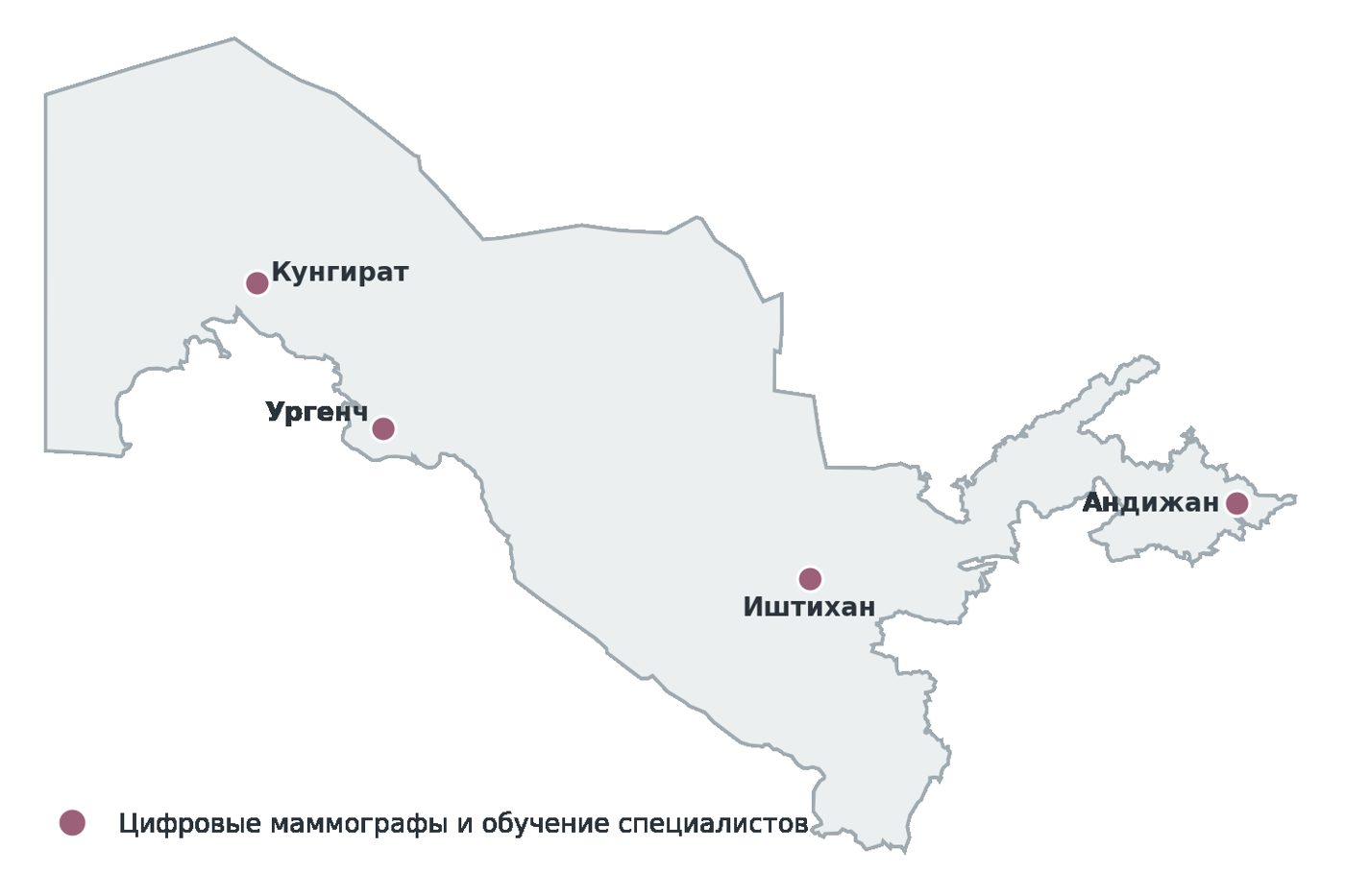
The 2025–2030 programme (PP-402, 22 November 2024) is the first national women's cancer programme with built-in, regular monitoring of results. Delivery Unit coordinates this work.
Years in the making, led by oncologists.
The initiative came from oncologists who wanted reliable data to plan and evaluate cancer care — led by Drs. Saide Janklich, Yahyo Ziyaev and Yakov Ten, working with experts from the International Agency for Research on Cancer (IARC). Integration with state information systems made it possible, for the first time, to verify data on cancer patients.
Monitoring and evaluation
Delivery Unit took part in designing the programme and was tasked with collecting and analysing data from primary sources — in real time and through field visits — tracking activities on the Geoportal, assessing targets, flagging problems and preparing recommendations for the Coordination Council.
It became one of the first pilots of a results-based approach to state programmes in Uzbekistan.
Skills where women need them.
Training covered both primary-care doctors responsible for early detection and the oncology specialists who treat patients.
22 master trainers
Since February 2025, at the Republican Center for Maternal and Child Health — the first IGCS-certified trainers in Central Asia. By the end of 2026, 209 doctors of “Onko-nazorat” rooms are to be trained through a cascade model.
13 oncologists
Grant-funded training for doctors of the Republican Oncology Center on multidisciplinary care. A multidisciplinary team has worked at the national oncology and radiology centre since late 2025.
Diagnosis closer to home
A gynaecologist from Samarkand region trained under IGCS now offers modern early diagnosis locally. Women who once travelled to Tashkent can be examined near home — saving time and money, and shortening the path to treatment.
“Erta aniqla — Hayotni saqla”
Detect early — save a life. The faces of the campaign were women who had beaten breast cancer. It united the state, doctors, businesses, media and patients around one idea: early detection saves lives.
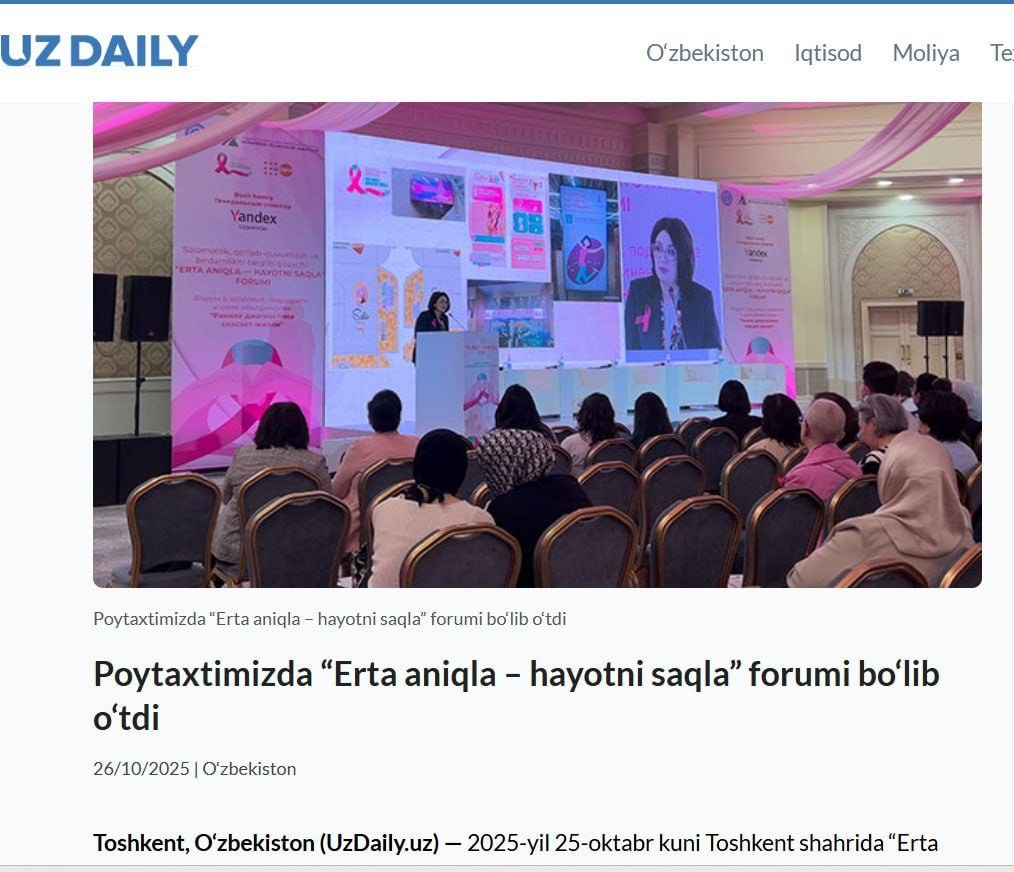
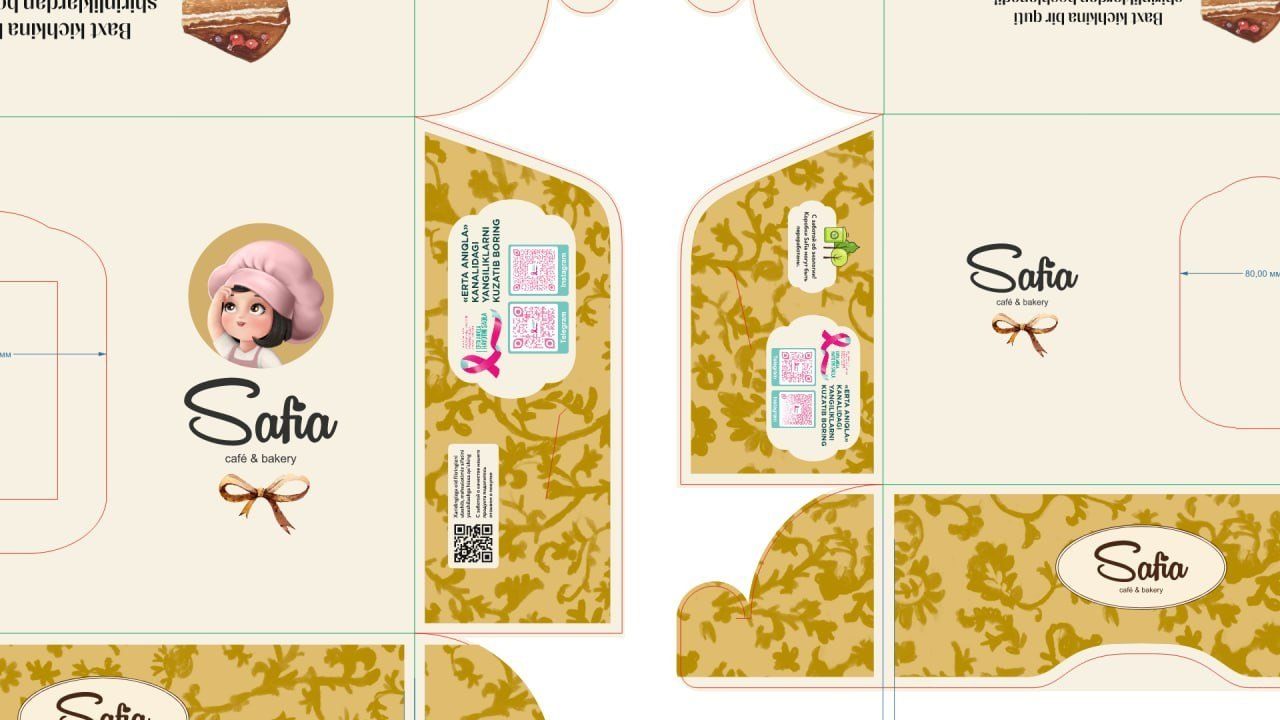
With Safia, Korzinka and Bon in their stores, the Ministry of Transport in airports, metro and buses, Anhor.uz among the first media supporters, and the “Transformation” project with O'zbechka salon. Held in October 2025 with UNFPA, Yandex and the NGO “Hamroh”.
The country's largest nutrition survey.
Prevention is impossible without data. The national Nutrition Survey covered 15,000 people (63.4% men, 56.9% urban). Nearly half of families spent more than 68% of their budget on food — yet diets stayed unbalanced.
What people ate the day before
Many families had to save on vegetables, dairy and other sources of good nutrition. For the first time, the state could see the real reasons — and design prevention around the daily lives of millions of families, not assumptions.
What else changed
- About 10,000 people at the first Healthy Lifestyle Festival
- State Programme to support breastfeeding until 2030 adopted
- Adolescent and child nutrition studied with partners (UNICEF)
- Unified food-safety control “from field to table” supported
Intake 2–3 times below the norm.
A large share of iodised salt on the market did not meet quality standards — with no ban on non-iodised salt and weak quality control. Amendments to the Law “On the prevention of iodine-deficiency diseases” were prepared and discussed in the Senate's Defence Committee and at a Senate plenary session.
Pesticides and food safety.
For two years we raised the safety of pesticide use, including research on long-term exposure such as DDT, widely used on cotton until the late 1980s. After hearings in the Senate committee and an interagency working group, the head of state decided to create a single Food Safety Committee.
Changing habits, not just informing.
Even the best programme fails if people don't know the risks or trust the advice. We worked with communicators, creative industries, NGOs, doctors and opinion leaders to make campaigns clear, emotional and close to people.
Hygiene with “Bek va Lola”
A new animated film on sanitation and hygiene by the creators of the “Bek va Lola” series helps children learn the basics in a fun way.
Watch on YouTube ↗Tai chi to a 10,000-person festival
Training for tai chi instructors for older people, then the first Healthy Lifestyle Festival with about 10,000 participants — sports communities, young people, families and volunteers.
A national programme to 2030
Joint work led to the State Programme to support breastfeeding until 2030 — one of the most effective tools to protect the health of mother and child.
Safe technology, protected patients.
We recorded cases of medical equipment used without proper control, tests without full informed consent, access to personal health data without clear safeguards, and weak oversight of research. We proposed a law on bioethics — common rules for medical practice, science and education that protect patients, prevent conflicts of interest and build trust in health care.
The key effect: policy now looks beyond treatment, to the factors that shape health long before a hospital visit — food, environment, product safety, awareness and ethical standards.